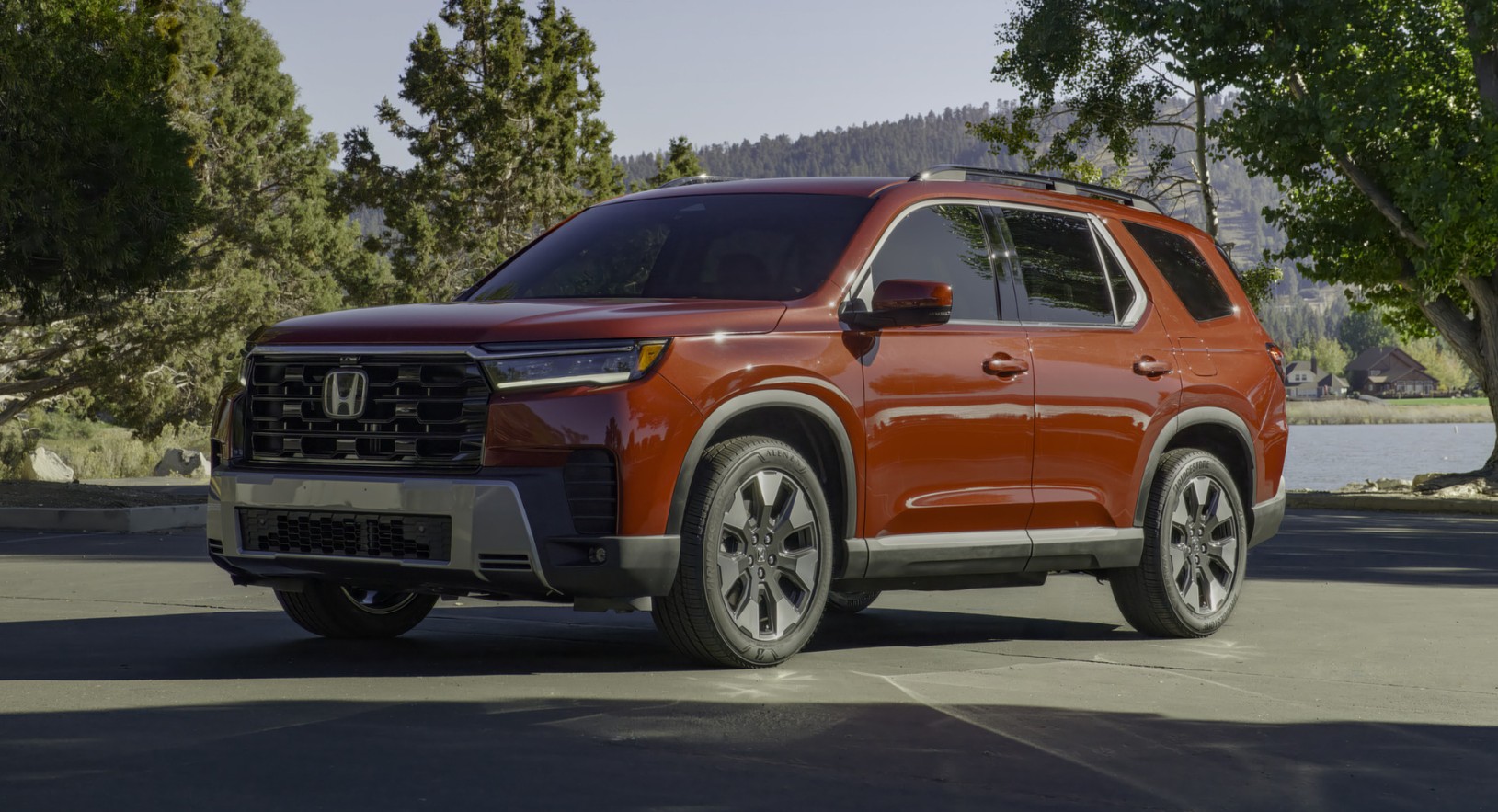
2028 Honda Pilot Review, Price, Changes – The 2028 Honda Pilot is expected to attract considerable attention from families searching for a spacious three-row SUV that combines practical everyday transportation with strong performance, modern technology, and the flexibility to handle longer adventures. The Pilot has established itself as one of Honda’s most important family vehicles, offering seating for up to eight passengers, a powerful V6 engine, generous cargo capacity, and available all-wheel drive. Its appeal comes from a straightforward approach: provide enough room for a growing family without making the vehicle unnecessarily complicated to operate. For 2028, buyers will naturally want to know whether Honda plans to introduce a redesigned exterior, a more advanced interior, improved fuel economy, or a hybrid powertrain that could make this large SUV more efficient.
The latest confirmed foundation is the refreshed 2026 Honda Pilot, which received meaningful improvements to its appearance, technology, cabin comfort, and driving experience. Honda introduced a larger front grille, revised front and rear styling details, a 12.3-inch touchscreen, a 10.2-inch digital instrument display, wireless Apple CarPlay, wireless Android Auto, Google built-in, and 5G Wi-Fi capability. The company also improved steering feel and reduced cabin noise through additional sound-insulating materials. These upgrades give the current generation a more modern character and make a major difference to everyday usability. Consequently, the 2028 model could build on this updated package rather than immediately require an entirely new generation.
A complete redesign for the 2028 Honda Pilot has not been officially confirmed. The current fourth-generation model was introduced for the 2023 model year and received its substantial mid-cycle refresh for 2026. That timing makes another full exterior and platform redesign in 2028 possible but far from certain. A more measured expectation would be continued development of the existing architecture, potentially with revised equipment packages, new exterior colors, updated software, improved cabin materials, and additional convenience features. Honda may also refine suspension calibration and noise insulation to make the Pilot more comfortable during long journeys. Until the manufacturer publishes its 2028 specifications, these possibilities should be regarded as expectations rather than confirmed production changes.
The biggest long-term question concerns electrification. Honda has publicly announced plans to introduce its next-generation Honda Hybrid system globally beginning in 2027, with 15 next-generation hybrid models planned by the end of the fiscal year ending March 31, 2030. The company has also discussed launching large hybrid vehicles in North America in 2029. This strategy makes a future hybrid Pilot an interesting possibility, especially as competition in the three-row SUV market increasingly emphasizes efficiency. However, Honda has not specifically confirmed a 2028 Pilot Hybrid, its engine configuration, or its launch timing. The safest expectation is that the conventional gasoline Pilot remains the baseline until Honda announces a specific hybrid model. 2028 Honda Pilot Review
2028 Honda Pilot Redesign and Update Plan
Exterior & Interior
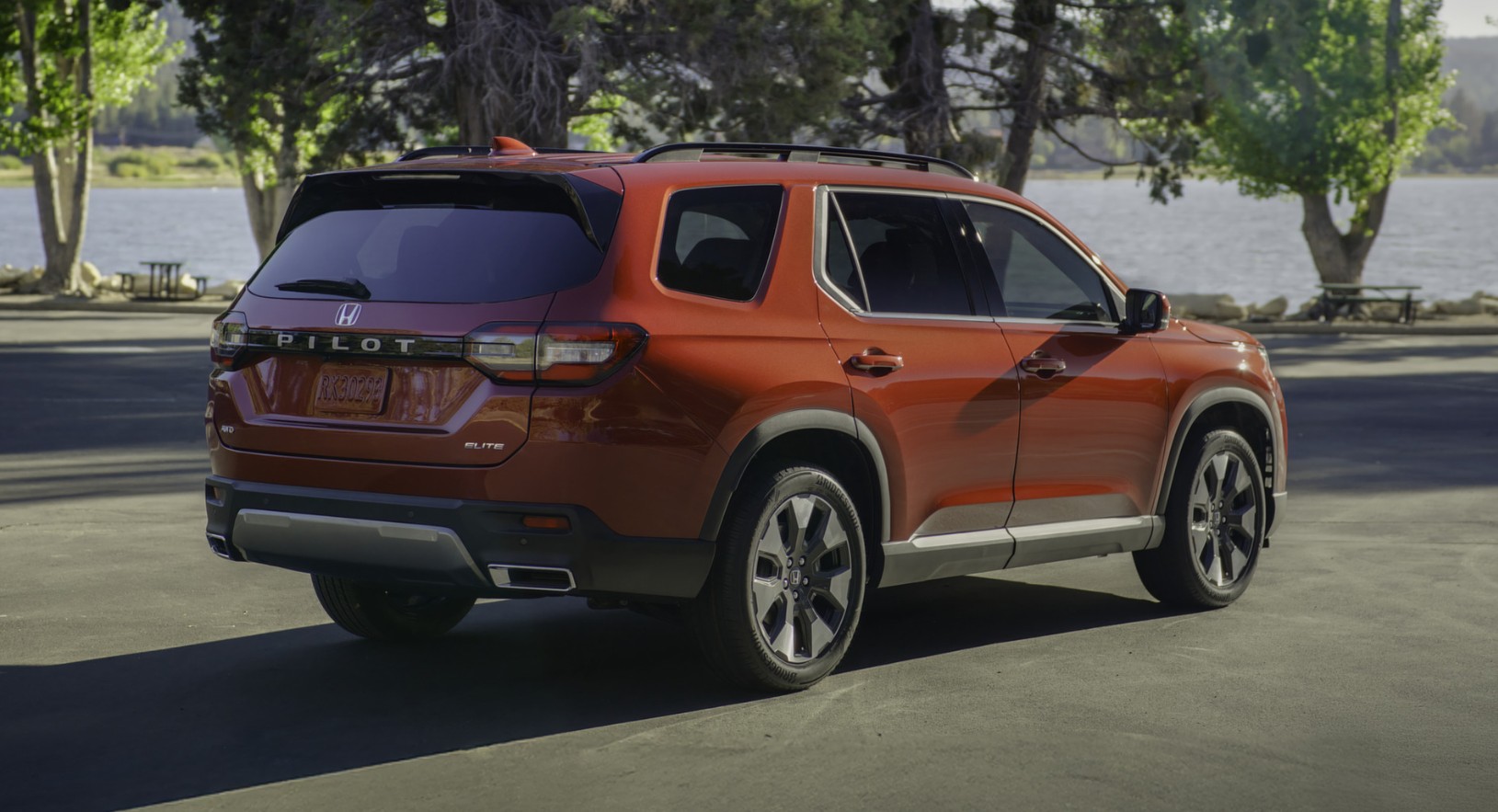
The exterior design of the 2028 Honda Pilot should retain the bold proportions that distinguish the current SUV from smaller crossovers. Its broad front end, upright grille, strong shoulder lines, squared wheel arches, and substantial rear section give it a confident appearance on the road. The 2026 refresh already introduced a larger grille and more pronounced front and rear scuff plates, creating a tougher visual identity. Sport and EX-L models use their own grille and exterior finishes, while the higher Touring, Elite, and Black Edition versions receive distinctive styling details. If Honda continues the existing design for 2028, small changes to lighting, wheel designs, bumper trim, and paint choices could keep the vehicle looking current without changing its overall proportions.
The TrailSport version is likely to remain the most adventure-focused member of the Pilot family. It features a more rugged appearance and equipment intended for drivers who regularly encounter gravel roads, muddy tracks, and uneven surfaces. Its raised stance, all-terrain-oriented tires, protective details, and standard all-wheel drive give it a different personality from the more road-focused trims. The 2026 model also benefits from a distinctive Ash Green Metallic exterior color, while available brown leather upholstery with orange stitching gives the cabin a more outdoors-inspired atmosphere. For 2028, Honda could introduce additional TrailSport-exclusive colors, wheel finishes, or protective accessories, although no new package has been confirmed.
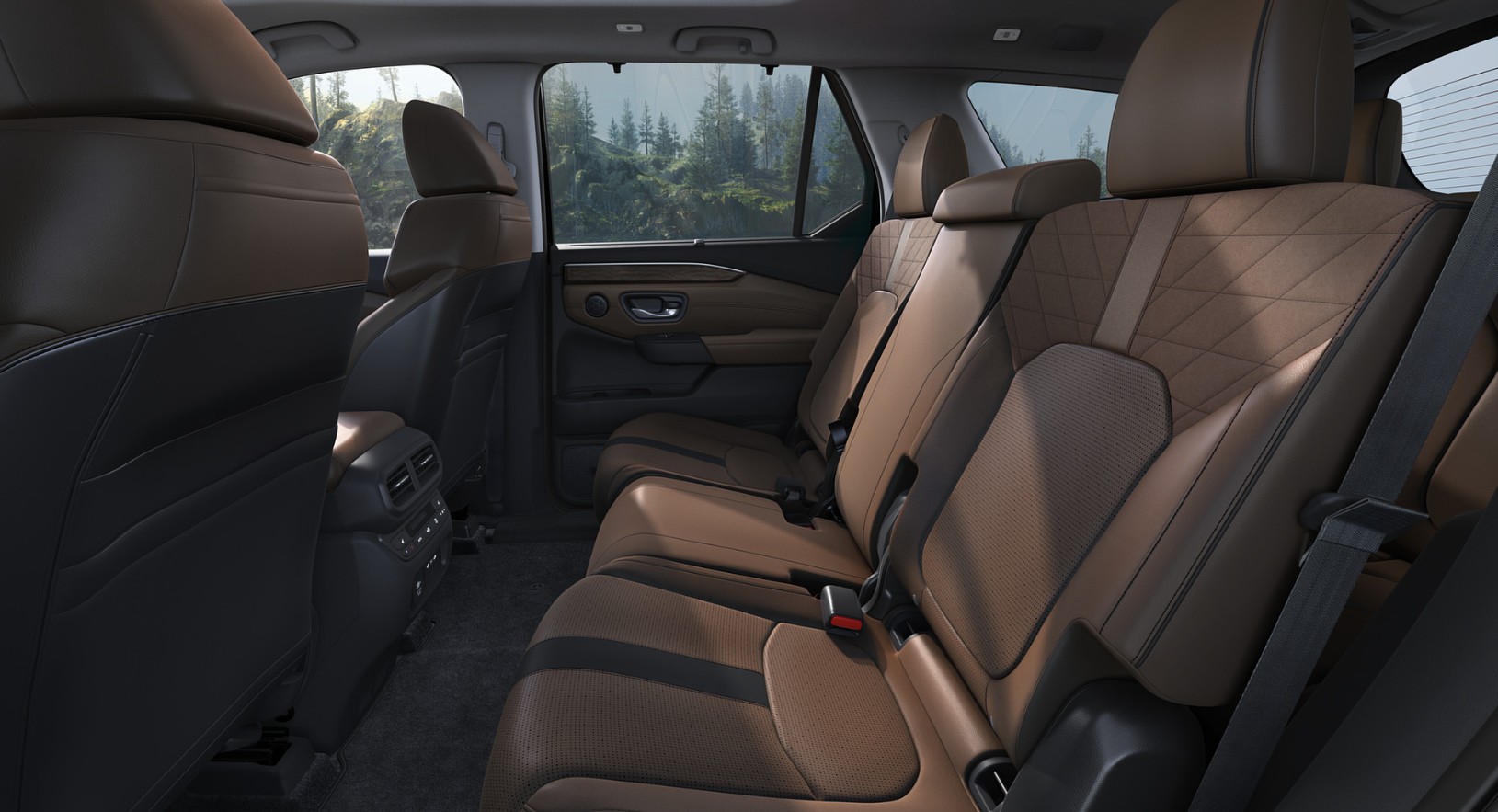
Inside, the 2028 Honda Pilot is expected to continue prioritizing passenger comfort and flexible family use. The current cabin provides three rows of seating, with configurations that accommodate seven or eight occupants depending on the trim. The second-row arrangement is particularly useful because selected versions include a removable middle seat, allowing owners to switch between a traditional three-person bench and a pair of captain’s chairs. This flexibility is valuable for families with children, passengers who need easier access to the third row, or owners who occasionally carry larger items. The Pilot also offers a practical cargo area, with maximum cargo volume reaching approximately 112 cubic feet depending on trim and configuration. These measurements make it a useful vehicle for vacations, airport trips, shopping, and outdoor equipment.
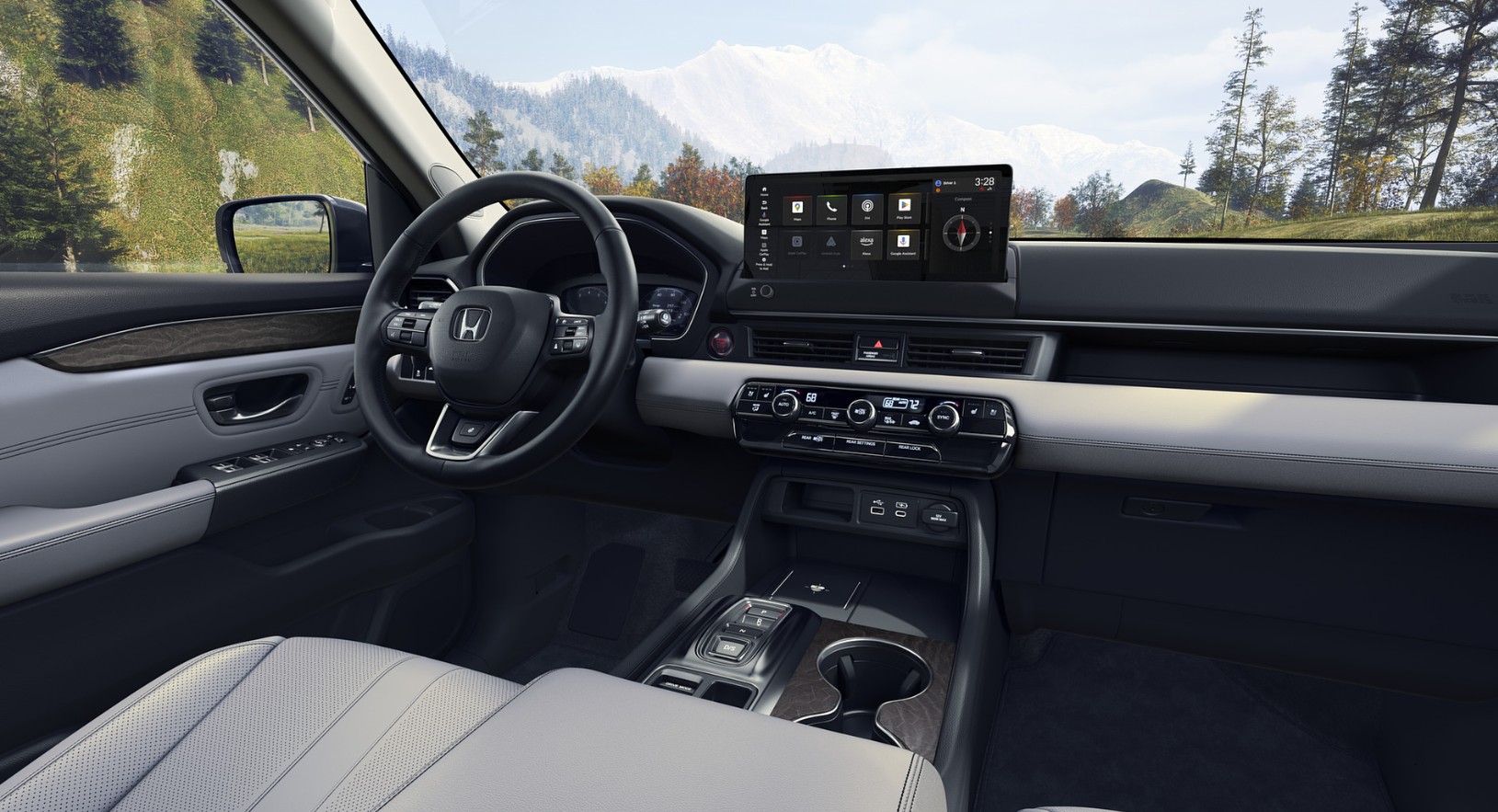
Technology should remain one of the Pilot’s strongest selling points. The 2026 update brought a 12.3-inch central touchscreen and a 10.2-inch digital instrument cluster, giving the dashboard a more contemporary layout. Wireless Apple CarPlay and Android Auto reduce the need for cables, while Google built-in provides integrated access to selected Google services and navigation functions. The available 5G Wi-Fi capability can also help keep passengers connected during longer journeys. Honda has improved cabin insulation as well, using additional sound-absorbing materials and revised glass to reduce unwanted engine, road, and wind noise. For the 2028 model, further improvements to interface responsiveness, connected services, charging convenience, and rear-seat entertainment would be welcome, but the final equipment list remains unknown.
2028 Honda Pilot Specs
Engine & Performance
The conventional 2028 Honda Pilot is expected to retain a naturally aspirated 3.5-liter V6 as its primary gasoline powertrain if Honda continues the current mechanical configuration. In the 2026 U.S. specification, this engine produces 285 horsepower at 6,100 rpm and 262 lb-ft of torque at 5,000 rpm. Its output provides the Pilot with the strength needed to carry a full passenger load, accelerate onto highways, and maintain speed when climbing hills. The naturally aspirated layout also delivers predictable throttle response without relying on turbocharger boost. Although a hybrid alternative could eventually join the range, Honda has not confirmed that the 2028 Pilot will receive one. Therefore, the existing V6 is the most reliable starting point for discussing the next model.
A 10-speed automatic transmission currently sends power to either the front wheels or Honda’s available all-wheel-drive system, depending on the selected trim. The transmission provides a broad range of ratios, helping the engine deliver useful acceleration while maintaining relaxed cruising behavior at highway speeds. Its multiple gears also support the Pilot’s towing and load-carrying responsibilities. Drivers can select different operating modes, including Normal, Econ, Sport, Snow, and Tow. AWD versions add Trail and Sand modes, allowing the vehicle to adjust its response for certain low-traction conditions. For 2028, retaining this transmission and drive-mode arrangement would preserve the familiar balance between smooth family transportation and useful performance.
Honda’s i-VTM4 all-wheel-drive system is an important advantage for buyers who frequently drive in rain, snow, or on unpaved roads. Rather than simply reacting after the front wheels lose traction, the system can actively distribute torque between the rear wheels to help the vehicle maintain stability and forward movement. This is particularly useful when accelerating out of a corner or traveling across a surface where traction differs from one side of the vehicle to the other. The TrailSport trim takes the concept further with its adventure-oriented equipment and additional drive modes. The Pilot is not a dedicated rock-crawling vehicle, but its available AWD hardware makes it better suited to rough-weather travel and moderate off-road routes than a conventional front-wheel-drive family crossover. 2028 Honda Pilot Review
2028 Honda Pilot Fuel Economy
Fuel economy will remain an important consideration because the Pilot is a relatively large SUV powered by a V6 engine. The current 2026 U.S. EPA figures provide a useful reference: front-wheel-drive Sport and EX-L models achieve 19 mpg in the city, 27 mpg on the highway, and 22 mpg combined. Most AWD versions are rated at 19 mpg city, 25 mpg highway, and 21 mpg combined, while the TrailSport returns 18 mpg city, 23 mpg highway, and 20 mpg combined. All versions use regular unleaded gasoline and have an 18.5-gallon fuel tank. The 2028 ratings have not been published, so these numbers should not be treated as final figures for the future model. If Honda eventually introduces a hybrid Pilot, improved fuel economy could become one of its most important advantages, but no official 2028 hybrid consumption estimate exists.
2028 Honda Pilot Safety Features
Safety is a major part of the 2028 Honda Pilot’s expected appeal, especially for families who regularly transport children and multiple passengers. The current model includes Honda Sensing as standard equipment across the U.S. trim range. This suite brings together driver-assistance technologies designed to help drivers recognize potential hazards and respond to changing traffic conditions. Its functions include the Collision Mitigation Braking System with pedestrian detection, Road Departure Mitigation, Forward Collision Warning, Lane Departure Warning, Lane Keeping Assist, and Adaptive Cruise Control with Low-Speed Follow. Blind Spot Information and Cross Traffic Monitor are also included in the current equipment package. These features provide useful support during highway travel, busy urban driving, and everyday parking situations.
The Pilot also benefits from a comprehensive approach to occupant protection. Its Advanced Compatibility Engineering body structure is designed to help manage crash energy, while the airbag system includes advanced front airbags, front knee airbags, side airbags, and three-row side curtain airbags. Additional standard equipment includes vehicle stability assistance, traction control, anti-lock braking, electronic brake distribution, brake assist, a tire-pressure monitoring system, and a rearview camera. Honda added Post-Collision Braking to the 2026 model, a system designed to help reduce the consequences of certain multiple-collision incidents after an initial impact. For 2028, we expect Honda to preserve a strong safety package, although any new sensors, software functions, or crash-protection improvements must be confirmed through the final specification.
Convenience technology can also improve safety when driving a vehicle as large as the Pilot. Its three-row body requires drivers to pay attention to the area around the vehicle, particularly when reversing in crowded parking spaces or maneuvering through narrow streets. The available 360-degree surround-view camera provides a broader picture of the vehicle’s immediate surroundings, helping drivers judge obstacles and parking distances. Blind Spot Information and Cross Traffic Monitor are particularly useful when changing lanes or reversing out of spaces with limited visibility. Depending on the trim, additional equipment such as parking sensors and low-speed braking control can provide further assistance. A future 2028 update could expand camera availability or improve the presentation of these systems, but the final configuration has not been announced.
2028 Honda Pilot Release Date & Price
The official release date for the 2028 Honda Pilot has not been announced. Honda has not published a confirmed reveal schedule, production timetable, or dealership arrival date for this model year. Based on normal automotive model-year planning, a reveal or first dealership deliveries during the second half of 2027 would be a reasonable possibility, but this is only an estimate and should not be treated as a confirmed launch announcement. The timing could differ by market, especially because Honda’s North American lineup and international vehicle offerings do not always follow identical schedules. Buyers should monitor Honda’s official newsroom and regional distributor websites for confirmed information about availability, specifications, and ordering.
The expected price of the 2028 Honda Pilot will depend on its final equipment, drivetrain availability, and any changes Honda makes to the lineup. As a reference, the current 2026 U.S. Pilot starts at approximately $42,395 for the Sport model, according to Honda’s current specifications and trim information. The EX-L begins around $44,695, while the TrailSport is positioned near $50,595. Touring starts at approximately $51,295, Elite at $53,695, and Black Edition at around $55,195. These figures are reference prices for the current model-year range, not confirmed 2028 MSRP figures. Destination charges, taxes, dealer fees, optional equipment, and regional pricing can increase the final amount paid by buyers.
For the 2028 model, a moderate increase over the current pricing would be plausible if Honda adds more standard technology, improves interior materials, or introduces additional convenience equipment. The entry-level Sport should remain the most affordable way to purchase a Pilot, while EX-L could continue to offer a useful balance between price and equipment. TrailSport buyers would pay more for its AWD-focused configuration and rugged styling, whereas Touring and Elite would appeal to customers who prioritize comfort and premium features. Black Edition would likely remain the flagship choice if Honda preserves the current hierarchy. Any hybrid version, if eventually introduced, could occupy a different price position because of its additional electrical hardware and battery system.
The 2028 Honda Pilot trim lineup is likely to follow the current range, although Honda has not confirmed the final model-year names or equipment combinations. The six principal U.S. trims are Sport, EX-L, TrailSport, Touring, Elite, and Black Edition. Sport provides the entry point with the V6 engine, practical cabin equipment, and a choice of front-wheel drive or available AWD. EX-L adds a more premium interior, including leather-trimmed seating and additional convenience features. TrailSport is aimed at buyers who want standard AWD and a more rugged setup, while Touring focuses on comfort and technology. Elite offers a more luxurious equipment package, and Black Edition sits at the top with distinctive dark exterior and interior styling. Honda could revise the lineup for 2028, but no new trim has been confirmed.
Conclusion
Overall, the 2028 Honda Pilot has the potential to remain a strong contender for families who need a capable, spacious, and comfortable three-row SUV. Its established strengths include a 285-horsepower V6, a 10-speed automatic transmission, available i-VTM4 all-wheel drive, flexible seating for up to eight occupants, modern connectivity, and a comprehensive Honda Sensing safety package. The 2026 refresh has already given the current generation a more attractive exterior, a larger touchscreen, improved cabin quietness, and additional standard equipment. The possibility of future Honda Hybrid technology adds another reason to watch the model’s development, although a 2028 hybrid Pilot remains unconfirmed. For buyers who value space, dependable everyday usability, and a proven gasoline powertrain, the next Pilot deserves a place on the shortlist while Honda prepares its official announcement.
Note: The bulk of the information in this blog post is sourced from references that were accessible prior to the product’s introduction. Seek information via official channels or connect with your local dealerships for the most up-to-date details.
Frequently Asked Questions
2028 Honda Pilot Review, Price, Changes - The 2028 Honda Pilot is expected to attract considerable attention from families searching for a spacious three-row SUV that combines practical everyday transportation with strong performance, modern technology, and the flexibility to handle longer adventures. The Pilot has established itself as…
The latest confirmed foundation is the refreshed 2026 Honda Pilot, which received meaningful improvements to its appearance, technology, cabin comfort, and driving experience. Honda introduced a larger front grille, revised front and rear styling details, a 12.3-inch touchscreen, a 10.2-inch digital instrument display, wireless Apple CarPlay, wireless Android…
A complete redesign for the 2028 Honda Pilot has not been officially confirmed. The current fourth-generation model was introduced for the 2023 model year and received its substantial mid-cycle refresh for 2026. That timing makes another full exterior and platform redesign in 2028 possible but far from certain.…
The biggest long-term question concerns electrification. Honda has publicly announced plans to introduce its next-generation Honda Hybrid system globally beginning in 2027, with 15 next-generation hybrid models planned by the end of the fiscal year ending March 31, 2030. The company has also discussed launching large hybrid vehicles…
2028 Honda Pilot Redesign and Update Plan Exterior & Interior The exterior design of the 2028 Honda Pilot should retain the bold proportions that distinguish the current SUV from smaller crossovers. Its broad front end, upright grille, strong shoulder lines, squared wheel arches, and substantial rear section give…